I have owned a pack of the Tumbling Dice 1/2400 Na’poleonic Ship Squadrons for a while, but after a test game of Fighting Sail by Osprey Games when they were half-painted, they lay forlorn on my shelf since that point until I rearranged my books and they were brought into the harsh light of day.
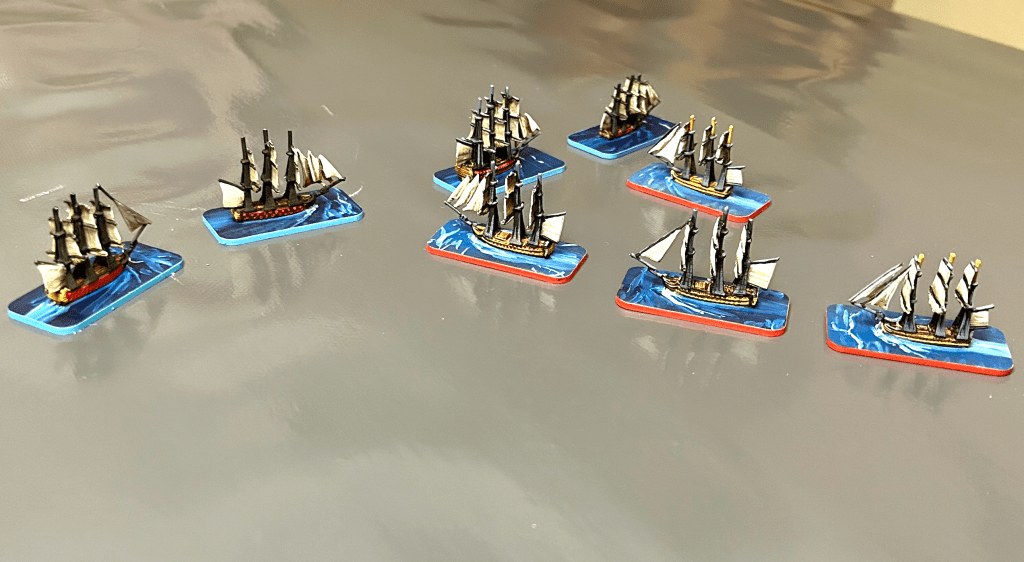
As per the header image, I tarted up the paintjobs and got them on the table for another small game of Fighting Sail. The normal game size is 300pts, I played with 200pts – so it was slightly smaller than average, but more than enough to refresh my memory of the mechanisms of the game.
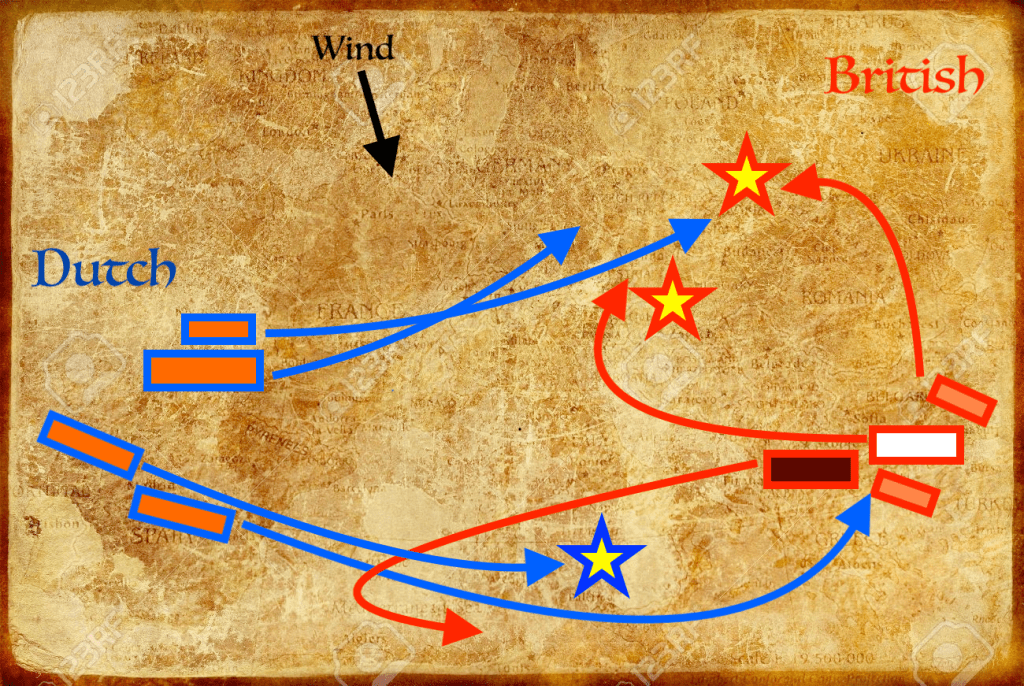
The Dutch fleet consisted of a 1st rate ship of the line, two 3rd rates and a 4th-rate, while the British fleet consisted of just two 3rd rates and two 5th rates, but of overall higher quality.
In the opening gambits the Dutch attempted to enfilade the southern British ships, but were counterpunched and lost a 3rd rate.
Midway through the wind changed, causing all ships to struggle to make way.
Towards the end of the engagement, the Dutch 1st-rate flagship and its attendent 4th-rate Frigate managed to pour enough fire into a British 3rd and 5th to cause them to sink, and the Brits struck their colours.
As a game, I think Fighting Sail has alot to recommend it – it’s probably the simplest naval game which still factors in wind direction and it’s impact on movement. Ship Statlines (Sailing, Boarding, Gunnery, Discipline, Hull) all represent numbers of dice rolled against a given target number – short range fire uses Gunnery and you need 3+’s, while rallying off disarray and damage uses Discipline and needs 6+’s.
The most interesting mechanic is around winning and losing – you have a morale score equal to 10% of your fleet cost (so a fleet of 200pts has a morale score of 20). When you take damage your fleet morale decrements too, and while individual ship damage can be rallied off during the game as the ships crew repair sails and clear the decks of wreckage, the morale lost is never regained – when it hits zero then you strike your colours.
There is definitely a feel of being a commodore and managing your ships, planning your movement with regard to the aspect of the wind and the ebb and flow of a naval engagement, and in terms of historical wargaming naval rules I think FS stands very tall indeed.
In my personal opinion, Age of Sail naval battles are far more entertaining to read about in the Patrick O’Brian “Aubrey-Maturin” novels than they are to play on the tabletop for two reasons:
Firstly, the game is effectively won in the movement phase and there is a great deal of planning required to manage impact of the wind, but this can be completely scuppered by your sailing rolls.
Secondly, the damage system has a high level of swing in it with so many dice being rolled with such varied chance – so difficult to estimate or plan around for both the attacker and defender. The impact of taking damage is to cripple a ship, but then that damage may be rallied off relatively easily.
Overall, nothing has really swayed my opinion that ships are going back on the shelf for now. While I’ve heard good things about fantasy-oriented naval games, I don’t think it’s the right time to start digging around in other naval rulesets with other projects that are more of a known quantity when it comes to entertainment are on the horizon.
Ultimately I think there’s something attractive about games being fundamentally human-centric rather than abstracted away too many levels. I think this is why I like 10mm wargaming: it affords clashes in the space I have available which look like battles rather than skirmishes, but in which you are still able to identify individuals, add meaningful identification to units and still have some character.


 William's Wargames
Leave a reply to lorenzoseventh Cancel reply