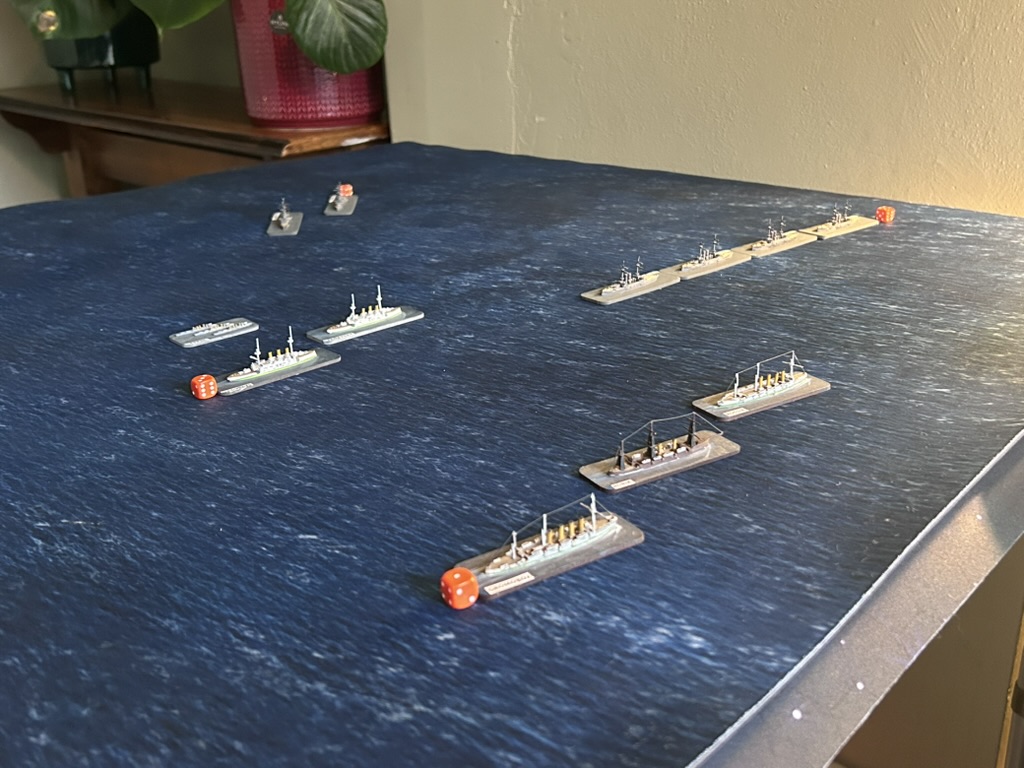
Grand Fleets is a game by Majestic 12 games which seeks to emulate naval wargaming up until the end of the battleship era in WW2, but largely focused on the pre-dreadnought period.
HMS Dreadnought was the first ‘all big guns’ ship on the sea, built by the Royal Navy in 1906 and essentially changed the paradigm for naval warfare for the next 30-40 years, but prior to that was an age of experimentation with many styles of ship and armament.
How does Grand Fleets play?
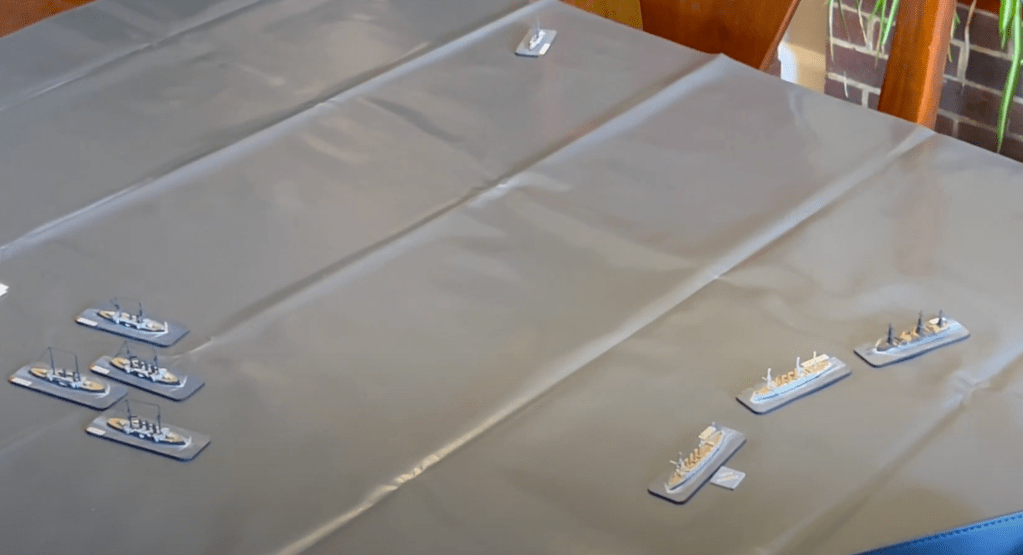
Grand Fleets divides each force into Squadrons, each operates independently with its own flagship and initiative roll. Initiative is crucial, because losing out means you have to move first, but fire last. This emphasises the critical nature of predicting movement and coordinated planning in naval warfare of the period, where although wind is no longer the determining factor, the inertia and bulk of these fighting behemoths must be accounted for.
Grand Fleets has an interesting combat mechanic – each ship’s guns are divided into batteries – typically one large for the main guns, one medium for secondary weapons, and then everything else bundled into ‘light guns’.
Firing is done by rolling a dice pool and aiming for 5’s – the initial size of the pool will vary based on the number, size and effectiveness of the weapns being fired, and decrement based on arc, armour piercing/value, crew quality, range, weather, etc. – and the number of successes is the amount of damage caused.
Each ship has blocks of damage capacity which are simply crossed off for each hit, and filling out a complete block causes a ‘critical damage’ roll, which may knock out guns, torpedos, cause fires or strike the magazine.
An example ship card is shown below, for the Royal Navy’s Canopus-class battleship:

I’ve played a couple of games of this system and they’ve generally been interesting.
Movement and initiative is very important in this game, to the extent that at a small unit count the game can feel like a pair of glass cannons firing at each other.
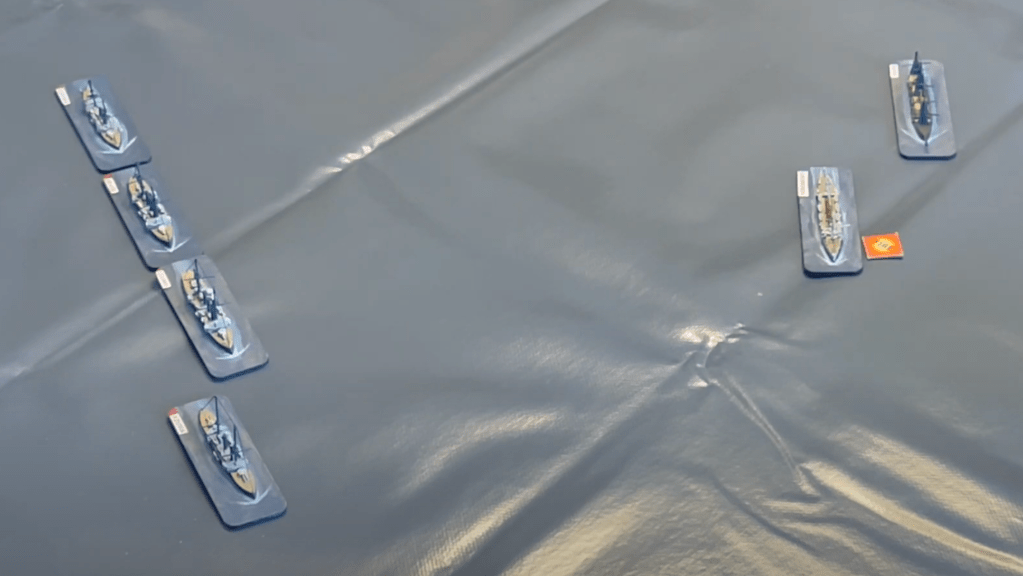
For example, the following photograph shows the Japanese 1st Squadron, having gained the initiative – has forced the Russians to move first, and fire last. This allowed Admiral Hikonojo to unleash a mid-range, four-ship broadside onto the Gromoboi which crippled it, and combined with the previous loss of the Rossiya, forced the Russian navy to strike its colours on one turn:
What don’t I like?
Though I’d flirted with Battletech, this was my first real interaction with datacard-based wargames, and for ships which at arms length look identical and have very similar statistics, it felt that a large portion of the differences could be more standardised weapon loadouts plus universal special rules, rather then subtly different stats.
One could argue that this flattening of profiles is directly contrary to the flexibility of the system, but I would argue that 99% of people playing this game are playing the pre-Dreadnought era and not WW2/Franco-Prussian/etc. so somewhat moot.
What would I do?
I have some ideas on how I would overhaul GF to make it a more accessible system – flattening the hull, speed, weapon range and dice pool mechanisms – but I don’t really have the experience to understand where things would start to come away at the seams.
As it stands, while GF is a fun game I don’t think it’ll ever really see the light of day on my table again.
 William's Wargames
Leave a comment