Having suffered through a pretty abysmal game of Mayhem, I thought I would re-play the scenario using Dragon Rampant, given my affection for Pikeman’s Lament.
Battle Report
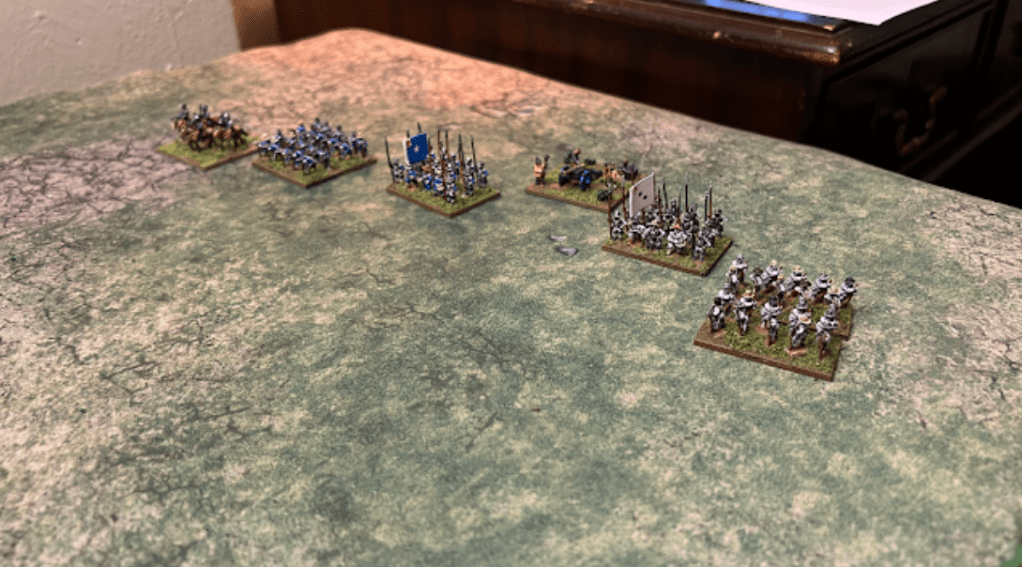
Lord Catte deploys his line in typical fashion – the centre alternating blocks of pike and shot, with pistolier horsemen on the flanks. The general rides with his Cuirassier Lifeguard just behind the front lines.

Baron Von Trinksblüt orients his battle line on the diagonal, but in a similar fashion – a core of bony spearmen in the centre flanked by dire wolves, and a central reserve of ghouls and mounted wights.

As dawn breaks, the lines manoeuvre for position, both armies sending their wings forward.

The first major clash of the day is a series of devastating combats initiated by the Dire Wolves on each flank, who drive their floppy-hatted opposition from the board.

Catte is able to unleash his musketry in good order and blast the centre ghouls into flight in return.

The centre of the board becomes a charnel house, with musket-fire criss-crossing the main road killing the other Dire Wolves.

Lord Catte himself launches a charge to break the centre of the undead ranks, hewing down the Mounted Wights and a regiment of Skeleton warriors. He almost has the day, but his impetuousness is his undoing, and is lured into a pointless charge off to the right flank.

While he is occupied, the Necromancer Trinksblüt summons another unit of Mounted Wights and sends them crashing into the fragile human infantry line. Everything is in the balance: Catte’s forces hounded on the left by Wolves, pinned in the centre by Wights, and on the right are still bogged down by the press of rotten wood and bones.

Trinksblüt gives the final coup de grace by sending arcs of green lightning from his fingertips into the Lifeguard Cuirassiers, burning their souls out in arcs of eldritch power. At the sight of their general reduced to a blackened husk, the rest of the Humans rout from the field, no doubt christened ‘Catte’s Folly’
 |
| Trinksblut’s Lightning Blast |
review
Command and Control
I played this battle with both commanders having the ‘Commanding’ trait, which grants a reroll of a failed action within 12″, and always permitted the first action to succeed. In some cases this still meant that an army only got off one activation each turn, but permitted slightly more tactical nuance than just hoping the roll goes your way.
familiarity
This was my first go at the Dragon Rampant rules, but I have played and enjoyed The Pikeman’s Lament a couple of times and it was all familiar ground. One thing I thought was conspicuous in its absence in DR was the snakeyes/boxcars special results from the order rolls in TPL. I wonder if this is because the matchups in TPL are fairly predictable and so randomness is desirable to keep the game interesting?
No rank and flank?
I appreciate that the ability to flank your opponent for a decisive advantage is a key component of most pre-Industrial Age wargames and this rules system does not have a mechanism for it. I do not yet feel it is weaker for it, however: the different target numbers to execute attack orders, and separate attack/defence values already has you utilise units differently, and in some cases you can sacrifice movement/shooting to act more defensively (i.e. Light/Heavy Foot can form a Wall of Spears: no movement, but +1 armour when attacked)
 William's Wargames
Leave a comment