If you spend any time at all searching for information and ideas about Solo RPG playing online, you can’t help but come across the idea that many people simply want to do a bit of guided creative writing, rather than actually playing the game – with only a vestigial and reluctant engagement of gameplay mechanics.
The creation and investigation of a dungeon (i.e. encounter zone) is one way to ground your narrative in the real world of the game.
In search of a system that can assist dungeon crawling, I would like to review the Deck of Many Dungeons and the TSR magazine ‘Strategic Review Vol. 1’ which I believe is the first iteration of the Gary Gygax-authored generation system which would persist into AD&D.
Deck of Many Dungeons
The Deck of Many Dungeons is, as one would expect, a card-driven system. You draw from a deck of cards, each representing a room or corridor, and use that to construct the dungeon.
Special cards are available to buy online, or you can print, cut and sleeve your own. You could also use a regular deck of playing cards and cross reference the results with your tables.
The dungeon comes together orthogonally and has very clear junctions and spacing. I really like how smoothly it works, but there are a couple of drawbacks – there is no real way to control the size of the dungeon, and there are many dungeon rooms defined on the cards which are totally empty or blank which contrasts sharply with the specific enemies/traps/treasure which are defined elsewhere.
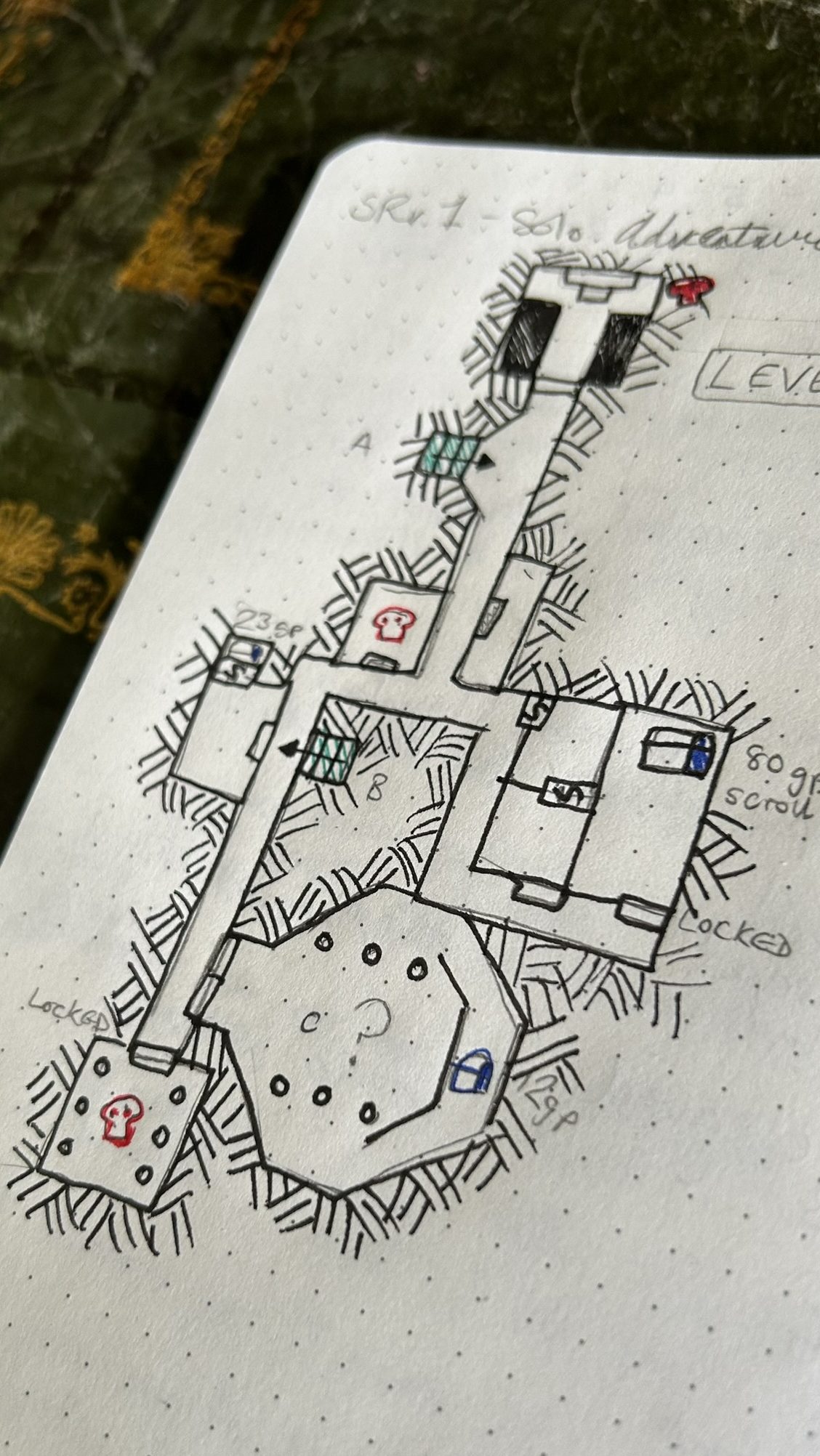
Strategic Review Vol. 1 – Solo Dungeon Adventures
Coming as one of the very first supplements to Dungeons & Dragons, I thought it would be worthwhile to investigate the SR Vol.1 “Solo <Dungeon> Adventures”.
Rather than the card-draw method of the Deck of Many Dungeons, this system has a Dice-roll based system: you roll for the size and shape of a room, the number of exits and the contents.
One of the emergent rules in the system is that any space beyond a passage is essentially infinitely long until you roll a periodic check which then determines what you see – whether a door, side passage, chamber, stairs or a dead end. There is no defined interval, so I have chosen to roll that check every turn – equating to three grid squares (or 30′).
A particularly frustrating part of the process is the number of side- and branch-passages which are generated, and the use of diagonals.
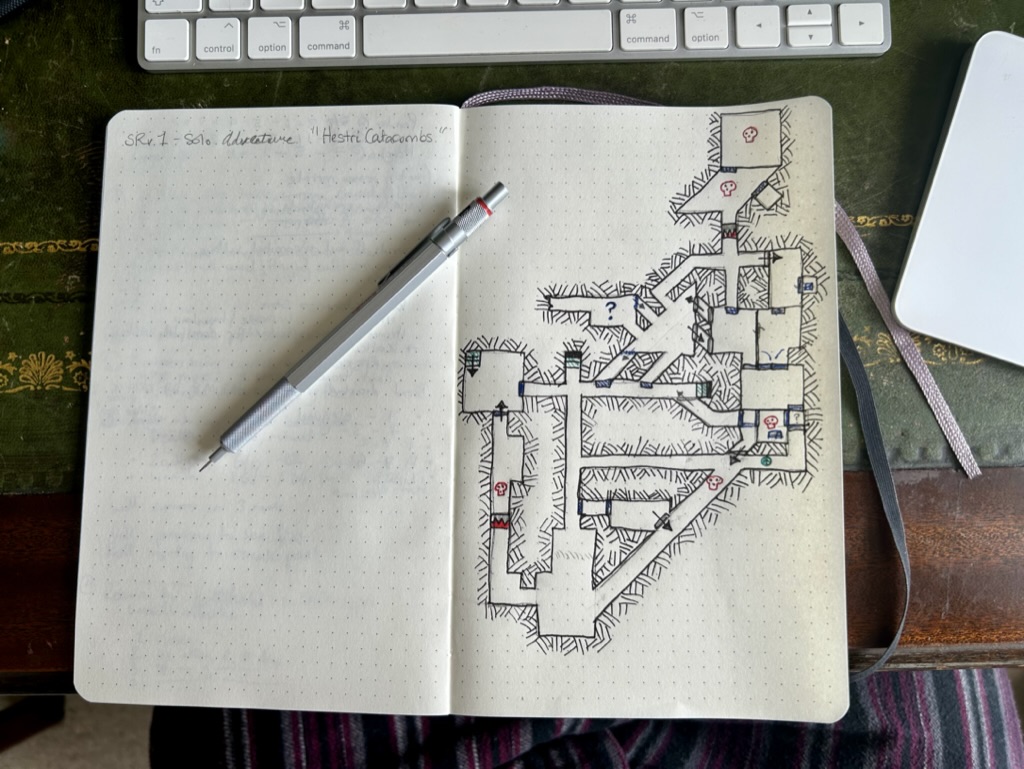
There are too many rooms with nothing in them, leading to more rooms with nothing in them. Definitely too many diagonal side passages and one-way doors – but these are all things you can smooth over with oracles, wandering monsters, etc.
Post-Creation Population
The original SRV1 article suggests the purpose of a procedurally generated dungeon is as a gameplay challenge and not balanced or with any kind of theme or purpose except that which emerges spontaneously.
One common workaround for procedurally generated dungeons is to use static proportions to determine the content of the dungeon as a whole, and then populate each room from that list.
For the example 17 room dungeon rolled up from SRV1 above, yields the following
| D20 Chance | Percentage | Actual | Room Content |
|---|---|---|---|
| 1-12 | 60% | 10 | Empty |
| 13-14 | 10% | 1.7 (2) | Monster |
| 15-17 | 15% | 1 | Monster + Treasure |
| 18 | 5% | 0.85 (1) | Special |
| 19 | 5% | 0.85 (1) | Trick/Trap |
| 20 | 5% | 0.85 (1) | Treasure |
The proportions seen here are close to that rolled in the dungeon generation for SRV1 – slightly more treasure and monsters, no specials – but there is of course the onus on you as GM and author to place these as you see fit.
Results
Overall, I have found both systems quite workable, but they suffer from the same problem:
Unless you want to boss-rush through the entire dungeon, there is a lot of empty and unused space which simply exists to burn lamp oil and enforce wandering monster checks.
A lack of flavour content in these generators is most explicitly felt when doing a solo dungeon crawl: you either have to accept a purely deterministic expedition as defined by a procedural generator, or do a good deal of legwork yourself, which is what I will be talking about next.

 William's Wargames
Leave a comment