I’ve been thinking about how to record my Solo RPG experiences, and thinking about whether they are worth sharing (and if so, how best to do that).
Maximalism
There is a general trend for maximalism in the hobby space – you can’t just paint figures, you have to aim to be a Golden Demon winner. You can’t just roughly sketch a grid on a piece of paper, you need a full Dungeon Tile set.
You can’t just scribble out some RPG notes on a piece of printer paper, you need to journal.

I am as guilty as charged of a kind of maximalism when it comes to wargaming. I generally prefer to play with fully painted armies using original rulebooks, paper army lists, etc. – so experimenting with different scales or settings ends up being a large upfront commitment of time, money and mental energy.
This has a double-edged effect of ensuring that the experience can be as enojyable as possible, but also that there is a large barrier for entry.
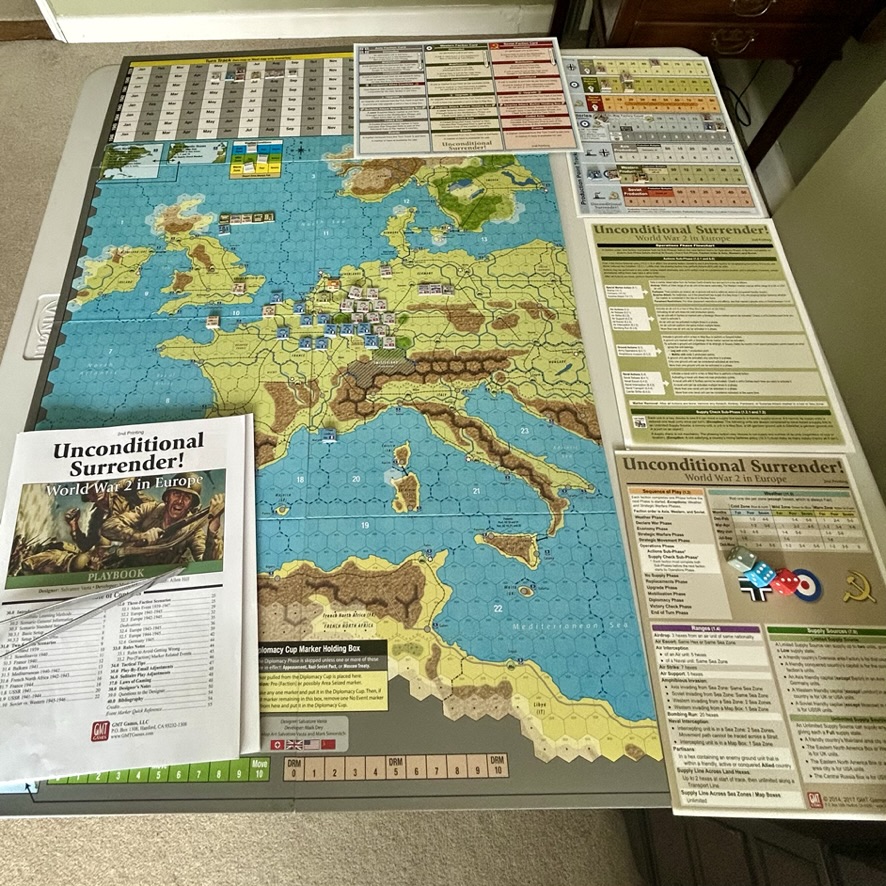
That barrier is part of the reason why, from time to time, I dip into board wargames and solo RPGs.
While I think the audience for ‘actual play’ RPGs and boardgames is vanishingly small, relaying my ideas and experiences playing is still something I find enjoyable.
I have spent some time testing and thinking about my options for non-wargaming content sharing, and want to share my ideas for solo RPG content.
Both the Sculptor and the Clay
Playing RPGs solo is an odd premise, because you acting as both the player and the DM. There is an implication that a solo experience requires note taking of some form – either as quick reference, stat tracking, or a fully formed narrative thread. You are engaging with the game in written form – but what form should that outut take?
Being the Sculptor
Though I’m sure there are many diverse reasons for people being attracted to TTRPGs and solo variants specifically – for me it is to spend time away from the computer screen, with marginal success.
The in-play experience of a game that is run through paper notes, drawings, maps and charts on paper is very satisfying in a micro-sense. You can have quick digressions to sketch character portraits, knock up an ad-hoc table or stat tracker (see below, my torch/encounter grid).
The obvious natural drawback to this is a risk (as also demonstrated below) of a lack of structure and readability:

While this is fine as a piece of reference work in-game, it is hard to pick out the important details or pick up a narrative thread. It does not make for captivating reading and is impossible to share effectively.
Focusing on the Clay
As an inveterate geek I’m in my natural habitat operating digitally, and a laptop-based journalling system such as Obsidian.
Being able to move and restructure content as appropriate feels like a huge benefit, as well as the added bonus that Obsidian content can be transferred here into the Blog fairly easily – there is even direct plugin integration.
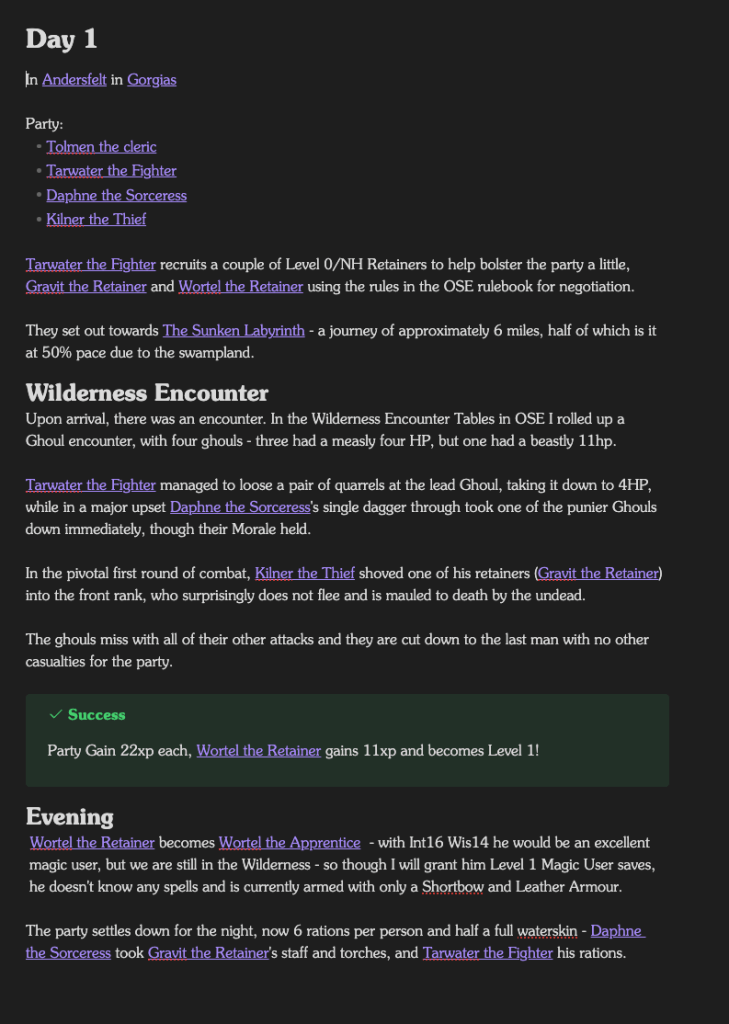
The Obsidian page above does illustrate the richness of experience with lots of cross referencing, built-in dice rolling, etc. etc. – and it makes for a fantastic experience when re-reading and for sharing.
A character can evolve from a retainer to a PC to an NPC with their refactoring catered for in the structure of the vault. Characters and be cross referenced with rumours, locations with points of interest and emergent patterns can evolve.
That is not unique to a mutable journalling system, but there is a comfort in knowing that I can drag and drop people, places, items, maps, dungeons and rumours.
False Friends
Clearly the fact that a digital journal can be rearranged is not a significant enough factor to decide for me – after all, once a structure reveals itself through enjoy play then that can be easily be replicated in the analoque world with a loose leaf binder and some punched paper sheets and sleeves.
To compare to a more recent similar issue, I am specifically thinking of how I just didn’t have the experience in BX D&D to understand what kind of non-combat items my characters needed, nor efficient ways to track or decide. With a few more games under my belt I can be reasonably certain of the kinds of equipment a party should have – it just required time behind the dice.
Time Behind the Dice.
Sharing my experiences of the hobby is important to me, and at this point it’s not clear whether a live streaming an analogue journal, or screencasting a digital journal is the best way to achieve that.
I would be interested to hear your thoughts – moreover do Solo RPG Actual Plays interest you at all, or are they destined to be something relevant to the player only? Please do comment below.
 William's Wargames
Leave a comment