What makes Starmada different to Battlefleet:Gothic or Void Admiral?
Unlike Void Admiral, an unabashedly GW-centric cinematic interpretation of space combat, Starmada hews more closely to hard science with (optional) rules for vector-based movement, frictionless combat, spooling hyperdrives, multiple fighter types and boarding-action sub-games.
Cinematic Options
While there are cinematic optional movement rules for either sailing ship-style(BFG) or ground vehicle-style (Starcraft), and the option of movie-style densely packed asteroid fields, Starmada’s default expectation is to slot somewhere in the hard sci-fi genre.
It would be fairly simple to translate a Space Marine Battle Barge into a Starmada stat-sheet and then use these cinematic rules to play out a BFG-style game, though that might be missing the point of both systems..
Meet the Fleet
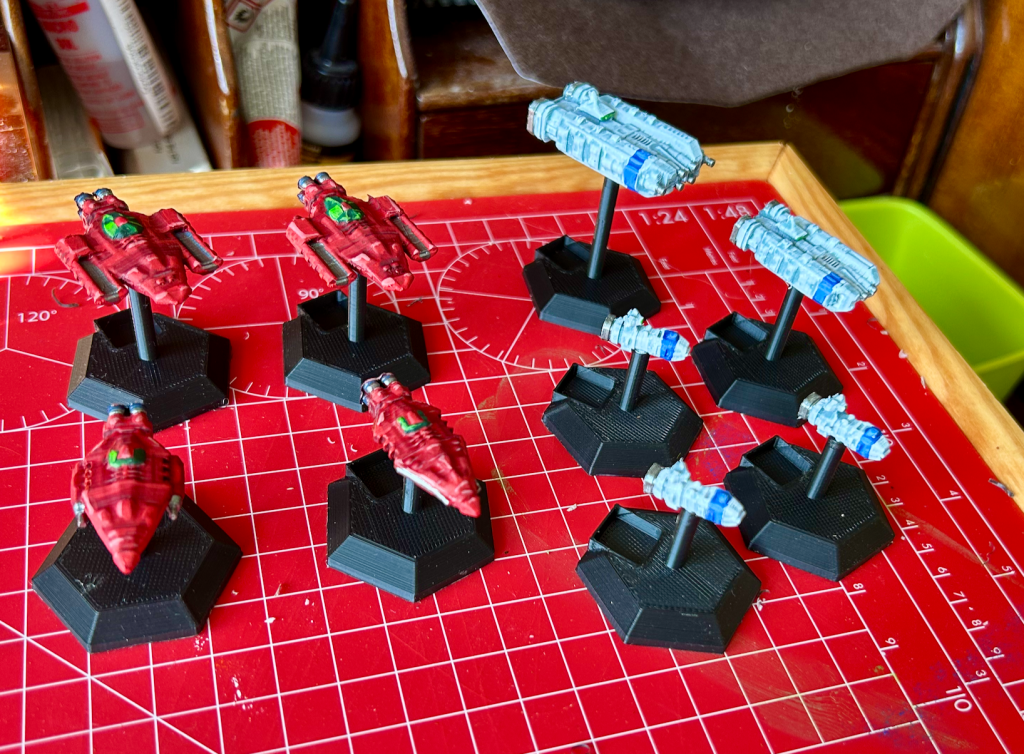
These are deliberately nano-scale ships to get them on the table quickly to test out Starmada and Void Admiral – but not so shabby as to be shameful. I designed the flight base myself, with a recess for a 10mm dice to for stat tracking. In Starmada this is likely to be inertia and for Void Admiral probably hull points.
A Starmap
When playing Man O War, I found the use of an appropriate mat to set off the miniatures worked wonders in generating visual interest. The vibrancy and colour kept me engaged with the game.
While it would appear that hex-overlaid battle mats are fairly common in the US they’re like hens teeth in the UK, and so I have ordered one custom-made from Etsy here with a 1.25″ grid.
Terrain for Starmada
As a result, the terrain requirements are fairly small – the gravitational pull of an entity is 2-3 times its size on the board (often only 1-2″), and the trope of a ‘gas cloud’ is swatted aside with the true statement that nebulae are so mind-bogglingly huge and dilute that even if they did affect a starship, it would be akin to night-fighting rather than shooting through hedgerows.
In a lot of cases it’s actually cheaper for me to either 3D model (or obtain models for) terrain and print it than to buy the source materials which feels a bit mad, but in this case makes sense:
- Mars: https://www.thingiverse.com/thing:3913448
- Earth and Moon: https://www.thingiverse.com/thing:1827001
- Asteroids: https://www.thingiverse.com/thing:2528035
Test Game
This is was the setup for my test game, a hexless white expanse:
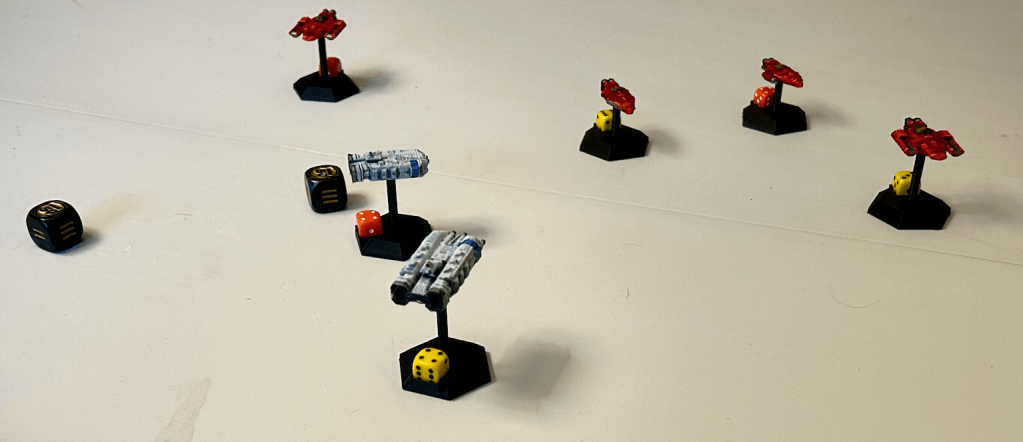
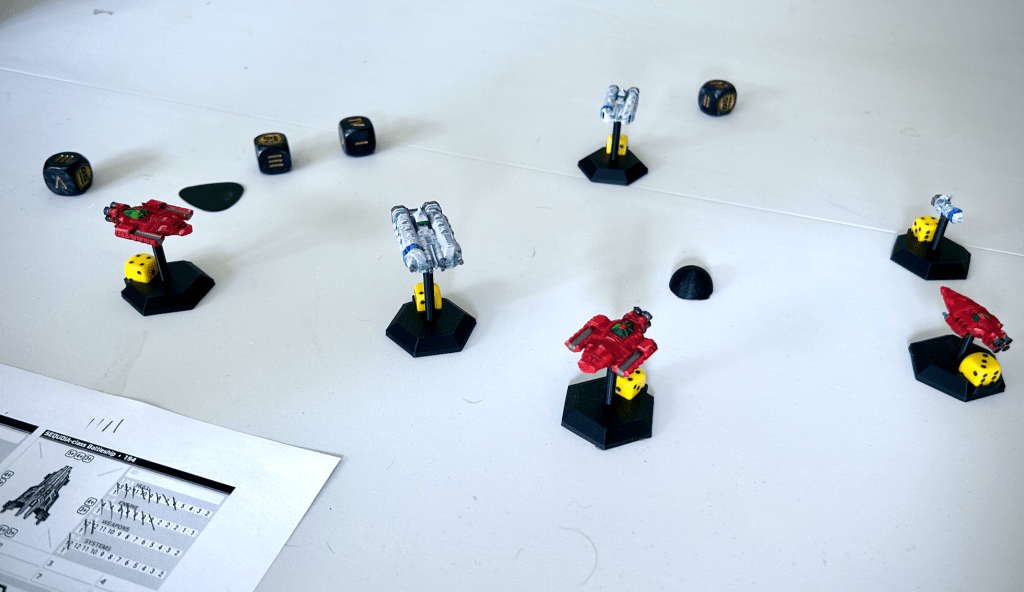
I did take a few more pictures of the game, but it’s basically just these ships flying around – since damage tracking is off-board. Given the pretty sparse visuals, it doesn’t LOOK like much has changed:
Battle Outcome
The result was a minor victory for the Renegades: early on they focused fire on the squadron of Imperial destroyers, and then were able to catch the Imperials in the crossfire. The Imperial fleet did put up a staunch resistance, but by the end of the game had lost most of their destroyers and both the Battleship and Cruiser were in dire straits.
First Thoughts
It was difficult to forge a narrative on the test game. My gut feeling is that it’s too small in scale and so ended up in a single, large swirling dogfight instead of separate engagements – but managing many more ships may end up being a bit too much cognitive load.
There were some notable events however:
Inertia and Frictionless Movement
The interia/engine rating system of the game made it fairly difficult to control the fleets, there was a kind of emergent set of rules that arose from the parameters in the rulebook, namely around turning – basically, ships who are travelling at a speed > ER cannot turn at all, and have to be travelling at ≤ ½ ER to turn more than once.
Oddly Balanced Weapons
The D6-damage Fusion Torpedos of the Renegade fleet did massive damage, wildly disproportionate to anything else on the tabletop. Conversely, the Imperial mines (shown above as the black dice/chits) were basically useless, doing a single point of damage that can be absorbed by shields or deflected by screens
What’s next for Starmada?
Well, I’m waiting on my hex mat to be delivered still – with the amount of measuring required for the game if played hexless it goes quite slowly and there’s a fair amount of ambiguity when it comes to angles, so I am hoping this is ironed out with the hex.
 William's Wargames
Leave a comment