Planet28 is a crunchy skirmish ruleset by Mammoth Miniatures. I was listening to this playlist as I gamed:
The Battle
The Judges, equipped with Plasma Rifles, a missile launcher and a leader with a Plasma Fist – go up against a quartet of Escher perps – giant weapons, primitive pistols, a shotgun and a sniper.
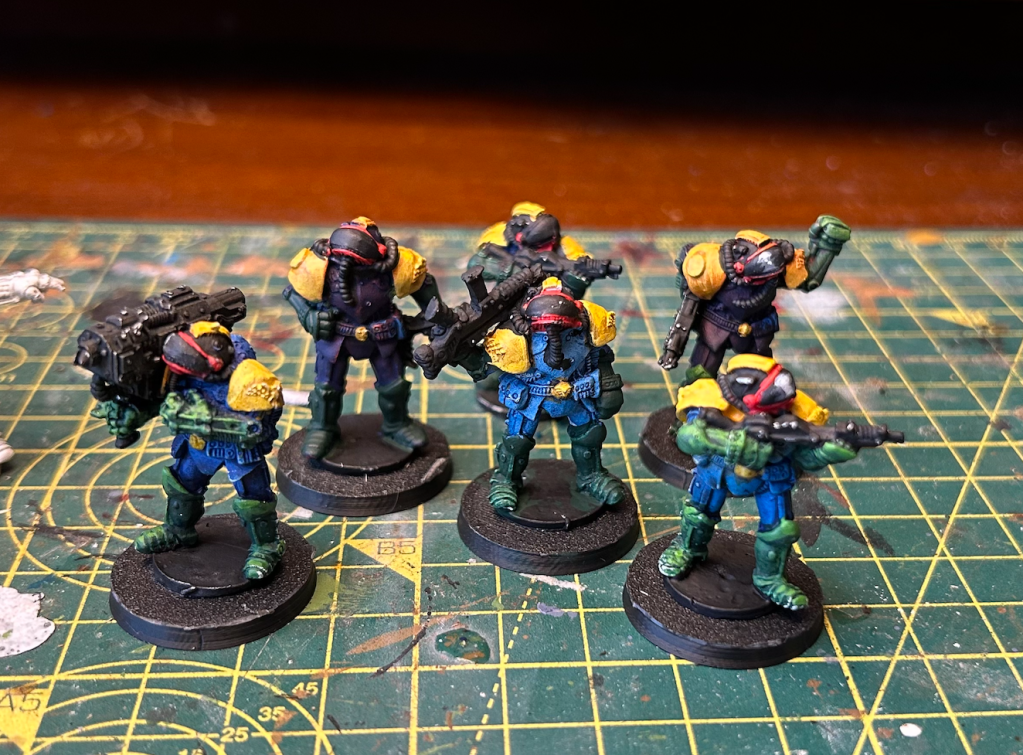
Hawk and Animal (the two close combat perps) have the highest agility and so spend the first couple of turns sprinting towards the Judges. Animal leaps off a cooling tower into combat with High Judge Gaunt causing terrible wounds but takes a powerfist to the jaw too. Units which haven’t taken an action that turn can use one to ‘counter attack’ during an Enemy’s Fight action.
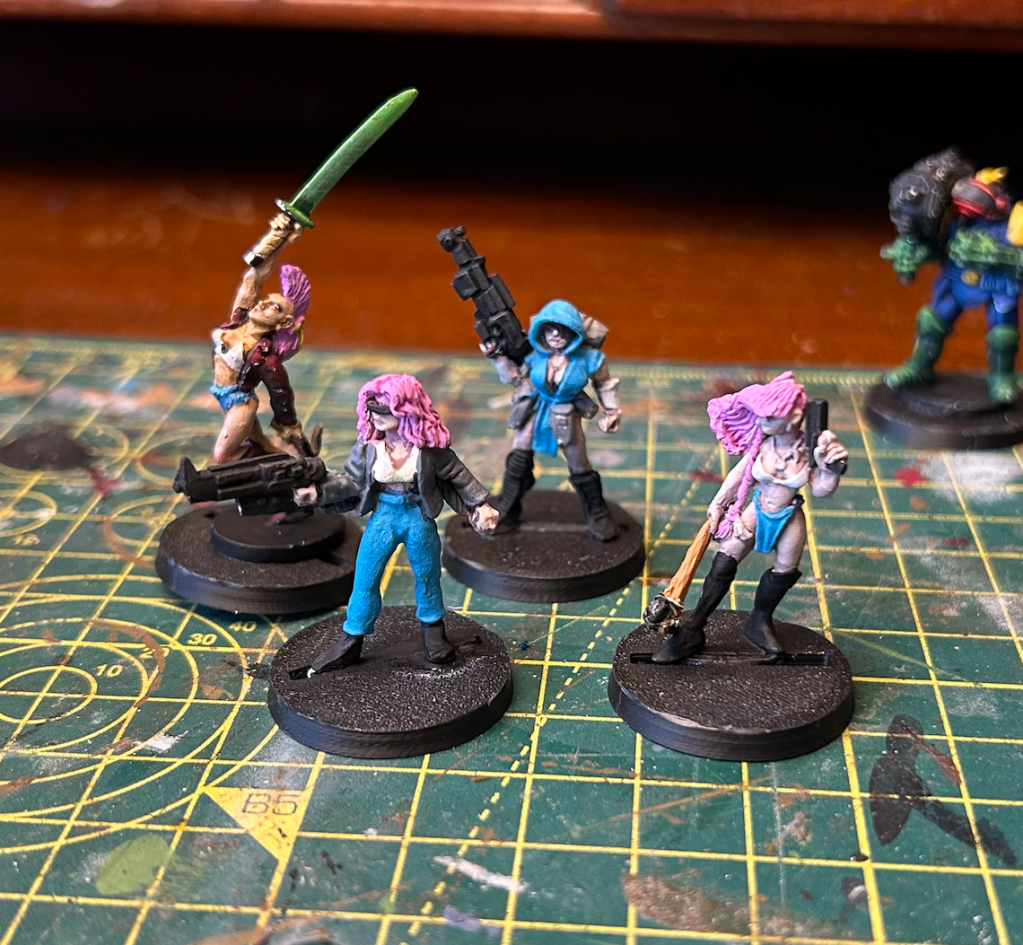
The Escher sniper “Doom” is able to land successive shots at the Judge with the Missile Launcher, but not enough to crack his tough ballistic armour, while the shotgun toting ‘Blast’ is able to rake her opponent with buckshot. Armour is a variable roll which subtracts from the damage roll of the weapon.
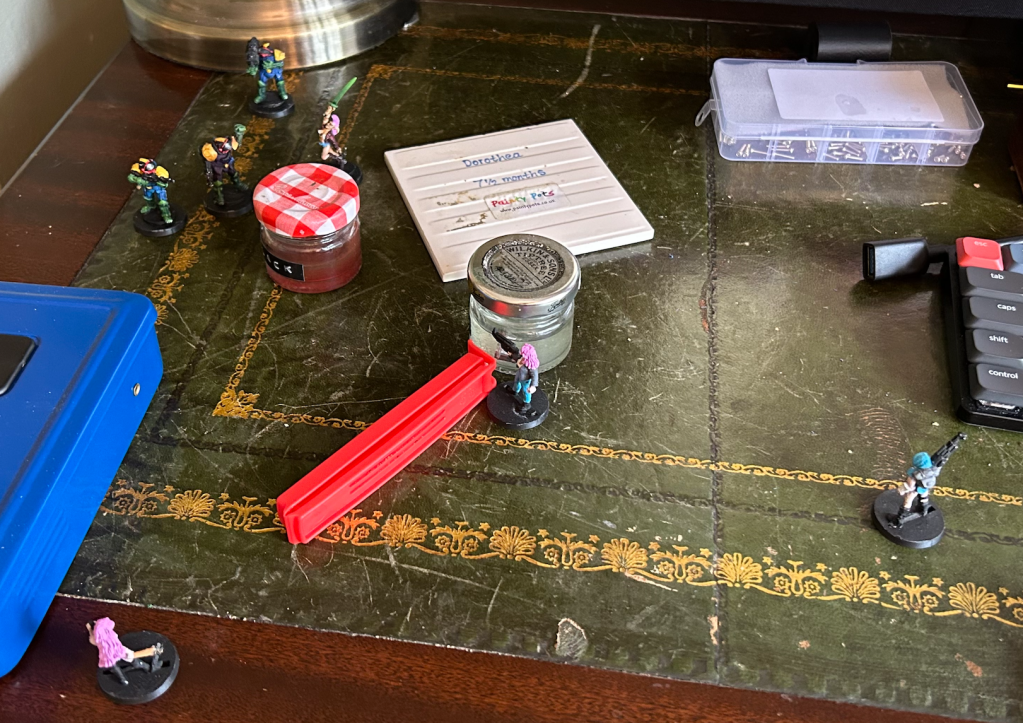
Judge Gaunt is able to lunge forward with another punch and smash Animal’s sword from her hand – she flees headlong into toxic sludge and is horrifically burned, taking her out. Units that are reduced to 50% HP much take a Psyche test and if failed, move immediately towards their board edge. Hazardous terrain requires an Agility test which if failed causes 1D10 damage.
Both Judge Smith and Judge Gaunt decides that enough is enough and head for home after taking damage from malfunctioning weapons and inconclusive melee, but Ramirez is able to retain the honour of the Justice Department by launching a missile into Hawk, who explodes in a shower of gore. Missile Launchers do 3D10+5 Damage!
Outcome
Though the Judges left the scene in a tactical retreat, the Escher had lost half their gang to casualties and so, this a victory for the Justice Department!
Thoughts on Planet28
When I first picked up the Planet28 rulebook I felt that it was a pretty heavy ruleset with lots of referencing and cross-checking, but I was mistaken. The core rules really are very simple – each character has two actions per turn and any time there’s uncertainty (trying to jump a trench, hit someone in combat, etc.) then you roll for it.
What makes P28 Different?
There are a few stand-out features of the game:
- Roll-Under: You are always trying to roll-under the relevant statistic (of six) on a D10
- Hold and Counter: Characters may choose to hold an action until later in the turn sequence, and characters that are attacked who haven’t yet acted always have an opportunity to fight back.
- Damage and Armour: Damage rolls are fun RPG-style – 2D12+3, etc. and yield big numbers – and armour rather than being a flat ‘save’, is another roll which negates that – such as the 1D8+4 value of the Judge’s ballistic armour.
What could be better about P28?
There are no examples in the P28 rulebook on a gang or force, and that’s left to you to figure out. It was only when playing the game I realised that Awareness and Psyche are useful statistics – the latter particularly because you need to roll under it to stop fleeing once a character take 50% wounds.
What’s next for me with P28?
The scope of the game seems very small indeed – between a single and half a dozen figures on each side, one vehicle, etc. and very much aligned towards the narrative experience. I would like the compare and contrast this game with Space Weirdos, an obvious alternative – and I think this game needs a run-through on a slightly larger space with some modified statistics: maybe a magic user and a vehicle?

 William's Wargames
Leave a comment